UML diagram tool for fast, collaborative modeling
Create UML diagrams online with Cacoo — simple, efficient, and perfect for team collaboration

What is a UML diagram?
Try it free nowA UML (Unified Modeling Language) diagram is a standardized way to visualize system architecture, behavior, and interactions. It helps teams document, analyze, and communicate system designs effectively.
Types of UML diagrams
Mind maps empower teams to visualize ideas, organize work, and collaborate seamlessly. Here’s how different teams benefit from using mind maps in Cacoo:
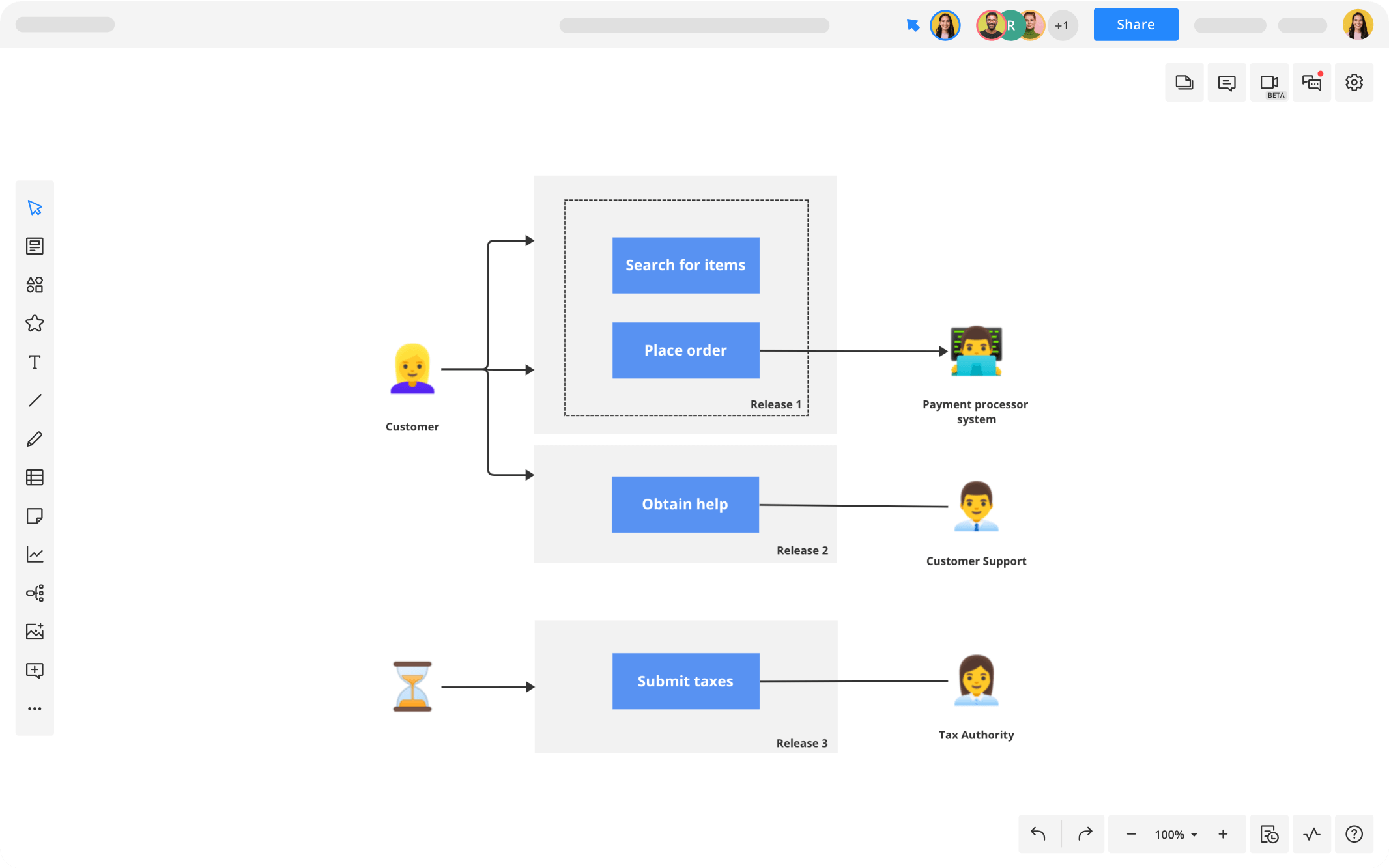

Use case diagrams
Use case diagrams illustrate how users (actors) interact with a system. They help define system scope and identify key functionalities by mapping out high-level user interactions. They are ideal for stakeholder discussions and early-stage planning.

Class diagrams
Class diagrams show the static structure of a system, including classes, attributes, methods, and relationships between objects. They are commonly used for object-oriented modeling and understanding system architecture.

Sequence diagrams
Sequence diagrams depict how objects communicate with each other in a time sequence. They're useful for showing the order of operations and message flow during a specific interaction or process.

Activity diagrams
Activity diagrams represent workflows, business processes, or system activities. Similar to flowcharts, activity diagrams are useful for modeling conditional logic, concurrent flows, and decision points.

State machine diagrams
State machine diagrams model the possible states of an object and its transitions triggered by events. They are useful for designing reactive systems like UI components, embedded systems, or protocol handlers.

Component diagrams
Component diagrams show how larger software components or modules are organized and interact. They are useful for understanding system modularity, service boundaries, and deployment dependencies.

Deployment diagrams
Deployment diagrams illustrate the physical hardware or infrastructure nodes and the software components deployed on them. They are useful for visualizing system topology and environment setup.
Who uses UML diagrams?
From engineering to product management, UML diagrams help teams clarify complex systems, collaborate visually, and document key decisions. Here’s how modern teams put UML diagrams into action:

Plan architecture and code interactions using class and sequence diagrams.

Outline system features and user interactions with use case diagrams.

Validate workflows and edge cases through activity diagrams.

Document deployment pipelines using component and deployment diagrams.
UML best practices for effective modeling
Try it free nowTo get the most out of your UML diagrams, it’s essential to follow best practices that ensure clarity, maintainability, and collaboration across teams. Whether you're modeling software architecture, system behavior, or business processes, these tips can help improve your UML diagramming efforts.

Use consistent naming conventions
Stick to clear, descriptive names for classes, objects, actors, and relationships. Avoid abbreviations unless they are well-known in your domain. Consistency helps others quickly understand the model and reduces ambiguity.

Keep diagrams focused and readable
Each diagram should communicate a specific concept or system view. Don’t overcrowd your diagrams with too many elements or layers—split complex systems into multiple diagrams (e.g., use separate class and sequence diagrams) to maintain focus.

Choose the right UML diagram for the job
Different diagrams serve different purposes. Use class diagrams to define system structure, sequence diagrams to model interactions over time, and activity diagrams for workflows. Selecting the appropriate diagram type improves communication and reduces rework.

Layer your architecture
Use a layered approach—such as separating presentation, business logic, and data access layers—to simplify complex systems. Layered diagrams also help with scalability, modularity, and maintenance planning.

Use standard UML notation
Adhering to UML’s standardized symbols and relationships ensures your diagrams are universally understood by other developers, architects, and stakeholders. This consistency is especially important when collaborating across teams or organizations.

Regularly review and update diagrams
UML models should evolve with your system. Outdated diagrams can mislead teams and cause implementation issues. Make it a habit to review and update your UML diagrams during sprints or major version releases.

Collaborate with stakeholders
UML diagrams aren’t just for developers—product managers, QA engineers, and business analysts also benefit from visual models. Share your diagrams early and often to gather feedback, align expectations, and reduce miscommunication.

Leverage templates and tools
Using a UML diagram tool like Cacoo with built-in templates, shape libraries, and version control features can accelerate modeling and reduce errors. Online collaboration features make it easier to involve distributed teams.
Why teams use UML diagrams

UML diagrams help teams visualize software structures, behaviors, and workflows, making it easier to align on how a system is built. When kept up to date, these diagrams serve as living documentation—supporting troubleshooting, upgrades, and handoffs over time.

By providing a shared visual language, UML diagrams reduce misunderstandings between developers, designers, product managers, and stakeholders. They streamline planning discussions, support cross-functional collaboration, and make requirements easier to map and validate.

Editable and lightweight, UML diagrams are ideal for fast-paced development environments. Teams can revise diagrams frequently to keep pace with evolving architecture and requirements—without needing to recreate visuals from scratch.
Integrate with your favorite apps
Connect Nulab products with each other and with your favorite tools to build a seamless, end-to-end workflow


Try Cacoo for UML diagramming today

Start diagramming in minutes
Try Cacoo free and see how easy visual modeling can be — no commitment, full access.
Try it free
Want a tailored walkthrough?
Schedule a quick call and we’ll show you how Cacoo fits your team’s needs.
Contact salesTRUSTED BY OVER 4 MILLION USERS WORLDWIDE




How teams use Cacoo to model systems and align faster
Cacoo is trusted by developers, architects, and cross-functional teams to create clear UML diagrams that improve communication and speed up system design. Here’s how organizations use Cacoo to drive alignment and results.
Read more"Cacoo offers just the right features that an Agile organization that wants flexibility needs."
Start diagramming with Cacoo today
Visualize your systems more effectively with UML diagrams that are easy to build, share, and present
Learn more about UML diagrams

Learn how to create UML diagrams with our guide
Our guide provides a concise, practical overview of Unified Modeling Language (UML) by walking readers through the different types of UML diagrams and showing how tools like Cacoo make it easy to visualize systems, clarify architecture, and enhance team collaboration.
Learn more